
Genetics
Key Facts about Genetics
Genetics
- Visit our key topics section and select ‘genetics’ from the drop-down menu to read a general introduction about genetics.
- Angelman syndrome is caused by missing or altered genetic information on the maternal copy of chromosome 15. This change typically occurs spontaneously during the process of gene copying and is not inherited from the mother. Humans inherit two copies of each chromosome—one from each parent— and have a total of 46 chromosomes.
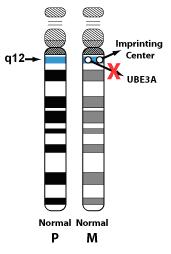
- The specific region of chromosome 15 affected in Angelman syndrome is called 15q11.2-q13. This locates the missing or altered genetic information to a specific area on the chromosome. We know now that the crucial gene affected in Angelman syndrome is UBE3A. While other genes in the region may also be impacted, the core features of Angelman syndrome are primarily due to alterations in UBE3A.
- Angelman syndrome arises when the genetic information on the maternal copy of chromosome 15q11.2-q13 is missing or altered. A similar region on the paternal copy of chromosome 15, when affected, results in Prader-Willi syndrome. This parent-specific gene expression is known as genomic imprinting.
There are different ways that the genetic information can be missing from 15q11.2-13. These are called “genetic subtypes” of AS. These are:
- Deletion:
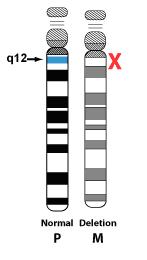
Deletion subtype
-
- Approximately 70% of individuals with Angelman syndrome have a deletion of the maternal (mother’s) copy of 15q11.2-q13. This results in the loss of genetic material. Although most deletions are similar in size, they are categorized into Class 1 deletions (slightly larger) and Class 2 deletions.
- Paternal Uniparental Disomy (UPD):
- Approximately 7% of individuals with Angelm
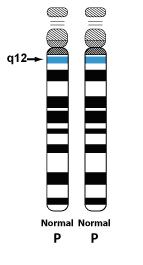
Unipaternal disomy (UPD) subtype an syndrome have paternal uniparental disomy (UPD), meaning both copies of chromosome 15 are inherited from the father, resulting in the absence of the maternal copy.
- Approximately 7% of individuals with Angelm
Imprinting Centre Defect:
-
- Approximately 3% of individuals with Angelman syndrome have an imprinting centre defect in the 15q11.2-q13 region. In these cases, the individual inherits chromosome 15 copies, but the critical maternal UBE3A gene is not properly expressed.
UBE3A Mutation:
- Approximately 11% of individuals with Angelman syndrome have a mutation in the UBE3A gene within the 15q11.2-q13 region. UBE3A is critical for brain development and protein turnover, and its mutation causes the characteristic features of Angelman syndrome.
- A small percentage of individuals with Angelman syndrome have mosaicism. This means that some of the cells in the brain have an unaffected copy of the UBE3A gene. Individuals with this genetic mechanism tend to have milder characteristics than other individuals with Angelman syndrome.
- Clinical Diagnosis:
- This subtype refers to individuals who have received a clinical diagnosis (a diagnosis based on physical features and behaviour) but after having blood tests are found to have no genetic difference (i.e. negative blood results for the above subtypes). Most of these individuals will not have Angelman syndrome but will have other similar and overlapping disorders, which should be considered during diagnosis. It is possible, however, that there may be other genes involved in Angelman syndrome and research is ongoing to try and discover more.
Prof Jill Clayton-Smith discusses genetic counselling in the following video:
For further information about genetic counselling in Angelman syndrome we recommend you visit Angelman UK.
Key Fact
Genetic information can be affected in four different ways in Angelman syndrome.

